
Episode
Modern Marvels: Building a Skyscraper: The Arteries
Overview
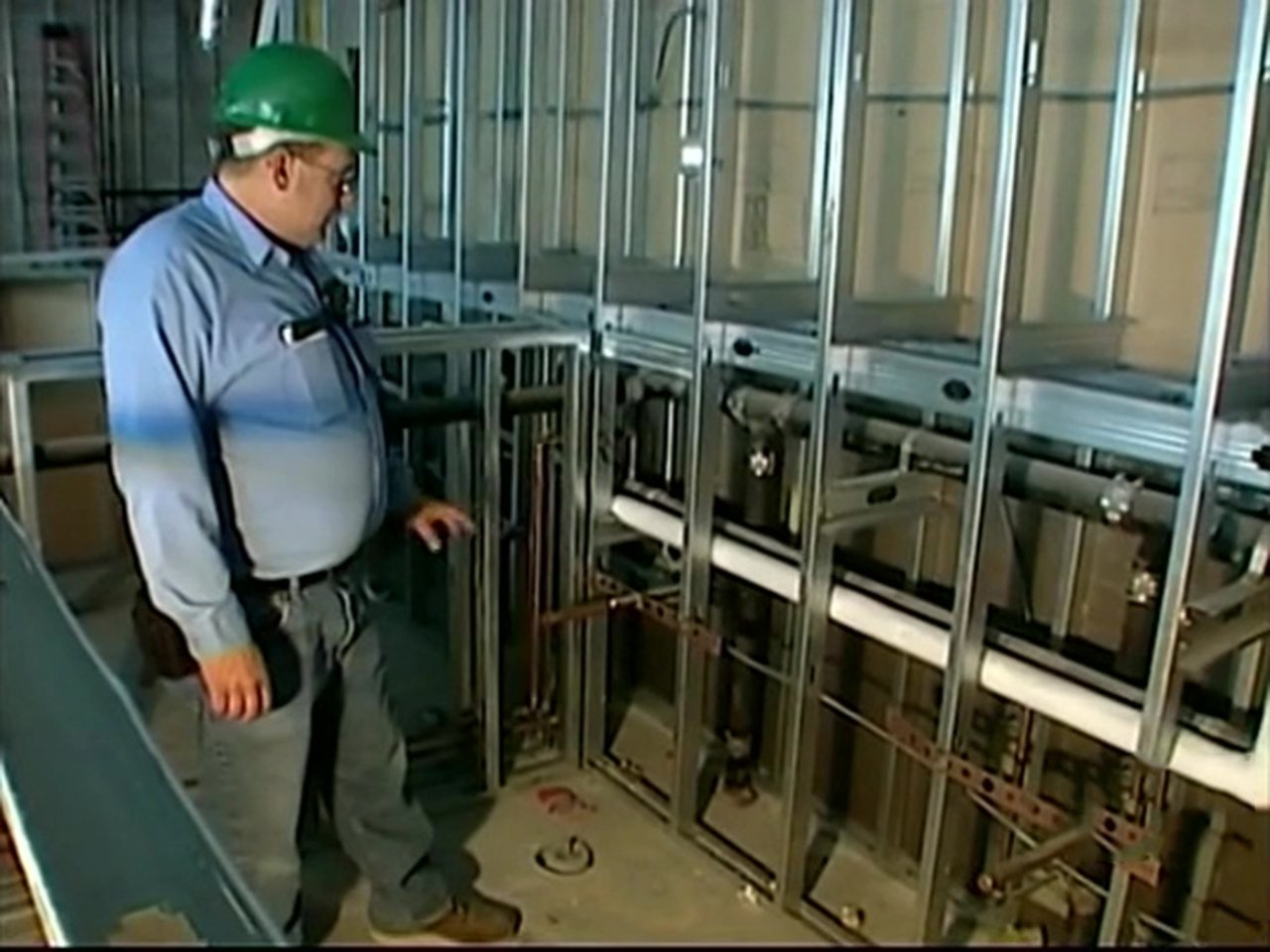
For two years, we’ve followed the construction of the new California Department of Transportation headquarters in LA to learn the architectural, structural, and mechanical challenges of building mega-skyscrapers. In hour four, as we’re installing the veins and arteries of the building and wrapping up construction on CalTrans, we learn how development of electricity and indoor plumbing made skyscrapers possible–imagine needing to take an elevator down 70 stories to use the privy behind the building!
Details
- Series
- Modern Marvels
- Season
- Season 11
- Episode
- Episode 38
- Air date
- 2004-09-07
- Runtime
- 44 min
Episode context
Building a Skyscraper: The Arteries is Episode 38 in Season 11 of Modern Marvels. It aired on 2004-09-07. The runtime is 44 min.
Previous / Next
 Episode 37: Building a Skyscraper: The Human Environment
In hour three of our crash course on mega-skyscraper construction, we learn about the human element and development of systems that make us comfortable. And we’ll see the evolution from freight hoists to today’s fastest high-speed pressurized elevators and, on the cooler side, the evolution from ice refrigeration to 3,000-ton chillers. We meet Bobby, the manlift operator and the building site’s standup comedian, and travel to Taiwan to visit the world’s fastest elevators in the TAIPEI 101.
Episode 37: Building a Skyscraper: The Human Environment
In hour three of our crash course on mega-skyscraper construction, we learn about the human element and development of systems that make us comfortable. And we’ll see the evolution from freight hoists to today’s fastest high-speed pressurized elevators and, on the cooler side, the evolution from ice refrigeration to 3,000-ton chillers. We meet Bobby, the manlift operator and the building site’s standup comedian, and travel to Taiwan to visit the world’s fastest elevators in the TAIPEI 101.
 Episode 39: The Sears Tower
Some 23,000 people walk through the Sears Tower’s domed entrances daily. 104 elevators (some double-decker), moving at speeds up to 1,600 feet per minute, transport workers and visitors to the 110 floors of North America’s tallest building. Sears, Roebuck and Company began as a small mail-order business in Chicago, and by 1960, had grown into the biggest global retailer. Sears Chairman Gordon Metcalf proposed bringing the company under one roof to create the world’s largest headquarters. Join us for a look at this pioneering building that remains a symbol of the future and a tribute to the company that dreamt big enough to build it!
Episode 39: The Sears Tower
Some 23,000 people walk through the Sears Tower’s domed entrances daily. 104 elevators (some double-decker), moving at speeds up to 1,600 feet per minute, transport workers and visitors to the 110 floors of North America’s tallest building. Sears, Roebuck and Company began as a small mail-order business in Chicago, and by 1960, had grown into the biggest global retailer. Sears Chairman Gordon Metcalf proposed bringing the company under one roof to create the world’s largest headquarters. Join us for a look at this pioneering building that remains a symbol of the future and a tribute to the company that dreamt big enough to build it!
More episodes from this season
Episode 36: Building a Skyscraper: The Exterior
For two years, we’ve followed construction of the new California Department of Transportation headquarters in downtown LA–a massive 700,000 square-foot office building–and we use this building as a specific example to illustrate construction problems of mega-skyscrapers, from the Empire State Building to the Sears Tower to the TAIPEI 101. In hour two, the steel skeleton is up, but before the windows and walls go up, the general contractor tests the exterior wall system by building a mockup.
Episode 40: St. Lawrence Seaway
The St. Lawrence Seaway is a monumental stairway in water, lifting massive ships hundreds of feet over thousands of miles. It’s the world’s longest inland waterway, a system of rivers, lakes, canals, dams, and locks that stretches 2,400 miles. And it’s one of the greatest engineering triumphs of the 20th century, pulled off against the violence of raging water and extreme winter. An essential part of the commercial infrastructure of the US and Canada, this complex system provides direct access from the Atlantic to North America’s heartland, enabling ships packed with trade to stop at any one its 65 ports–from Montreal to Duluth. From the 16th century, when French explorer Jacques Cartier searched for the legendary Northwest Passage, to the modern Seaway, built in the 1950s, we highlight the incredible engineering feats that went into creating the waterway.
Episode 35: Building a Skyscraper: The Skeleton
What does it take to construct a building that will cover an entire city block? Try 13,000 tons of steel, 36,000 cubic yards of concrete, enough wire and cables to stretch from New York City to Boston, hundreds of professionals, and two years of blood, sweat, and swearing. Welcome to Skyscraper 101. In the first hour, we see how architects design a building and check out the new California Department of Transportation headquarters–a project we’ve followed for two years.
Episode 41: Guns of WWII
Episode 34: George Washington Bridge
When opened on October 25, 1931, the George Washington Bridge was the longest suspension bridge in the world. Today, standing as a main traffic artery between Manhattan and New Jersey, the bridge referred to by locals as the “GW” is the busiest in the world, carrying nearly 320,000 cars each day. We’ll examine the construction methods employed that made the bridge an anomaly, coming in both under budget and ahead of schedule, and see why the GW is distinguished in a city of great bridges.
Episode 42: St. Lawrence Tech
 Episode 33: Engineering Disasters 7
Engineers and architects reveal what went wrong in five engineering disasters, including Baldwin Hills Dam that suddenly gave way, spilling liquid havoc in a quiet LA neighborhood; a mysterious plane crash that killed all aboard (Lockheed Electra); a massive freighter’s shuddering crash into Tampa Bay’s Sunshine Skyway Bridge; the 1994 Northridge, California earthquake that shook down poorly engineered buildings; and a 4-decade old coal mine fire that turned Centralia, Pennsylvania into a ghost town.
Episode 33: Engineering Disasters 7
Engineers and architects reveal what went wrong in five engineering disasters, including Baldwin Hills Dam that suddenly gave way, spilling liquid havoc in a quiet LA neighborhood; a mysterious plane crash that killed all aboard (Lockheed Electra); a massive freighter’s shuddering crash into Tampa Bay’s Sunshine Skyway Bridge; the 1994 Northridge, California earthquake that shook down poorly engineered buildings; and a 4-decade old coal mine fire that turned Centralia, Pennsylvania into a ghost town.
 Episode 43: Police Pursuit
Join us for a high-speed look at police pursuits in an adrenaline-filled hour focused on the history and evolution of the technologies that give law enforcement the upper hand when pursuing bad guys. From the days of chasing moonshine runners in “hopped up” vehicles during Prohibition to the most recent 100-mph freeway chases, patrol cars have undergone many advances. We also examine how communications have improved, the use of airborne resources, and pursuit on the high seas.
Episode 43: Police Pursuit
Join us for a high-speed look at police pursuits in an adrenaline-filled hour focused on the history and evolution of the technologies that give law enforcement the upper hand when pursuing bad guys. From the days of chasing moonshine runners in “hopped up” vehicles during Prohibition to the most recent 100-mph freeway chases, patrol cars have undergone many advances. We also examine how communications have improved, the use of airborne resources, and pursuit on the high seas.
 Episode 32: Extreme Aircraft
Join us for a supersonic look at some of the most cutting-edge aircraft ever developed–from the X-1 that first broke the sound barrier to the X-43 Scramjet that recently flew at Mach 7. These extreme aircraft have made their mark on aeronautical history, and sometimes on political history as well. The U-2 and SR-71 spy planes played a crucial role in the Cold War, and now Lockheed Martin's top-secret "Skunkworks" division is touting the new "air dominance" fighter plane– the F/A-22 Raptor.
Episode 44: SOS Tech
A look at the technology that changed the serious game of Search and Rescue forever. At the mouth of Oregon’s Columbia River, we visit the Coast Guard’s Motor Lifeboat School, the training ground for High Surf Rescue. Then, we trace the evolution of life-saving technology at sea, and learn why the EPIRP (Emergency Position Indication Radio Beacon) is the pleasure boater’s greatest friend. And we take a look at how the U.S. Navy deals with accidents classified as “Man Overboard” in the 21st century.
Episode 32: Extreme Aircraft
Join us for a supersonic look at some of the most cutting-edge aircraft ever developed–from the X-1 that first broke the sound barrier to the X-43 Scramjet that recently flew at Mach 7. These extreme aircraft have made their mark on aeronautical history, and sometimes on political history as well. The U-2 and SR-71 spy planes played a crucial role in the Cold War, and now Lockheed Martin's top-secret "Skunkworks" division is touting the new "air dominance" fighter plane– the F/A-22 Raptor.
Episode 44: SOS Tech
A look at the technology that changed the serious game of Search and Rescue forever. At the mouth of Oregon’s Columbia River, we visit the Coast Guard’s Motor Lifeboat School, the training ground for High Surf Rescue. Then, we trace the evolution of life-saving technology at sea, and learn why the EPIRP (Emergency Position Indication Radio Beacon) is the pleasure boater’s greatest friend. And we take a look at how the U.S. Navy deals with accidents classified as “Man Overboard” in the 21st century.