Episode
NOVA: The Case of the Ancient Astronauts
Overview
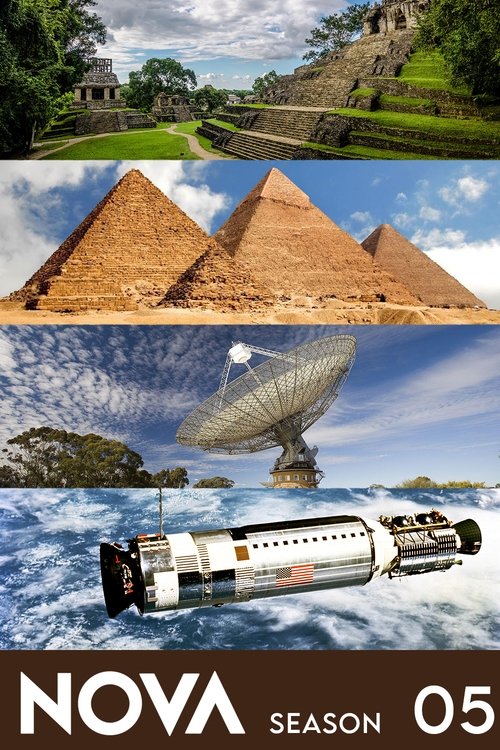
NOVA investigates the theories of von Daniken and others that the Earth has been visited by intelligent beings from outer space. Among claims examined are: that the building techniques used in the Great Pyramid of Cheops are so advanced that only an extraterrestrial intelligence could have built it; and that the engraved stones of Palenque in Mexico depict an ancient astronaut at the controls of a space rocket.
Details
- Series
- NOVA
- Season
- Season 5
- Episode
- Episode 9
- Air date
- 1978-03-08
- Runtime
- 55 min
Episode context
The Case of the Ancient Astronauts is Episode 9 in Season 5 of NOVA. It aired on 1978-03-08. The runtime is 55 min.
Previous / Next
Episode 8: The Great Wine Revolution
A science-based revolution in the making of wine is underway. NOVA traces the secrets of the aging process and science's involvement with the predicting of mass production high-quality vintage wines.
Episode 10: The Mind Machines
Today's scientists may be creating their own successors. Work being done in Artificial Intelligence (AI), a branch of computer science, only suggest that in the not too distant future, machines will outpace their creators. NOVA examines the possibility.
More episodes from this season
Episode 7: Trial of Denton Cooley
In a dramatic docudrama, NOVA reconstructs the controversial lawsuit raised against renowned heart surgeon Dr. Denton Cooley when one of his patients died after heart surgery, and examines the legal and moral issues this raises in the practice of modern medicine.
Episode 11: Icarus' Children
In the summer of 1977 Paul MacCready, a California scientist and businessman, won the coveted Kremer Prize. His achievement was to design and build an airplane which completed, unaided, a one-mile figure-eight course entirely under the power provided by the pilot himself. This is the story of those many failures and MacCready's success.
Episode 6: BaMiki BaNdula: Children of the Forest
In the rain forests of Zaire, in the heart of Africa, live the Mbuti Pygmies. The Pygmy way of life has always been extraordinarily difficult to capture on film, though many have tried. NOVA presents a rare portrait of an elusive people, made by an independent filmmaker who lived with the Pygmies and won their trust.
Episode 12: Still Waters
NOVA shows a year in the life of a beaver pond and includes almost every life form that exists in, on, under, around and above the water, from the microscopic plant life of summer to the eagles feeding on carcasses of deer that collapsed on the winter ice.
Episode 5: The Final Frontier
Second of the two-part series on space programs, NOVA looks ahead to the future, post-Apollo and the role that man in space will play, including the possibility of space colonization—huge orbiting space stations where people live and work in an earth atmosphere under artificial gravity.
Episode 13: Battle for the Acropolis
The fortified plateau above Athens known as the Acropolis is the site of some of the most remarkable architecture in the world: its marble structures built in the fifth century BC, including the renowned Parthenon, represent the artistic peak of classical Greek architecture. NOVA examines how the heavily polluted air of Athens produces acid rain which is dissolving the marble sculptures and columns; and how iron tiles used extensively in repair 40 years ago are now rusting, expanding and shattering the stone structures.
Episode 4: One Small Step
Part one of a two-part series on the subject of man in space, NOVA examines the history of NASA—from the origin of the space race through the triumph of the Apollo programs. By tracing the history of three key programs—Mercury, Gemini, Apollo—we show how the basic challenges surrounding space flight were answered: rendezvous and docking, life support, weightlessness, space sickness, equipment reliability and so on.
Episode 14: The Road to Happiness. : The Life and Times of Henry Ford
Henry Ford, a great friend of Edison, was a film enthusiast who amassed some one and a half million feet of film during his lifetime. Deposited in the National Archives and known as the Ford Film Collection, it covers not only the Ford family and Ford Motor Company but also contains newsreels, and general films produced under Ford. Using the Collection, NOVA profiles Ford's life and times.
Episode 3: Blueprints in the Bloodstream
It has been known since the turn of the century that there are four human blood groups, based on different red cells and serum characteristics. NOVA looks at the more recent discovery that the different white cell types, as determined by a variety of different molecular markers on the cell surface, open up the possibility of the prevention of disease.
Episode 15: Laser : Light of the 21st Century
When first invented 18 years ago, lasers were called "a solution looking for a problem;" nobody could think what to do with them. But in fact research scientists immediately began to exploit their pure colors and near-perfect focusing ability. Today lasers have grown into a billion-dollar business. They are used in construction, manufacturing, clothing, dentistry and medicine. And the future uses of lasers are likely to be of major significance as the means of achieving nuclear fusion and as a very high efficiency communications medium.