
Episode
NOVA: Earth From Space
Overview
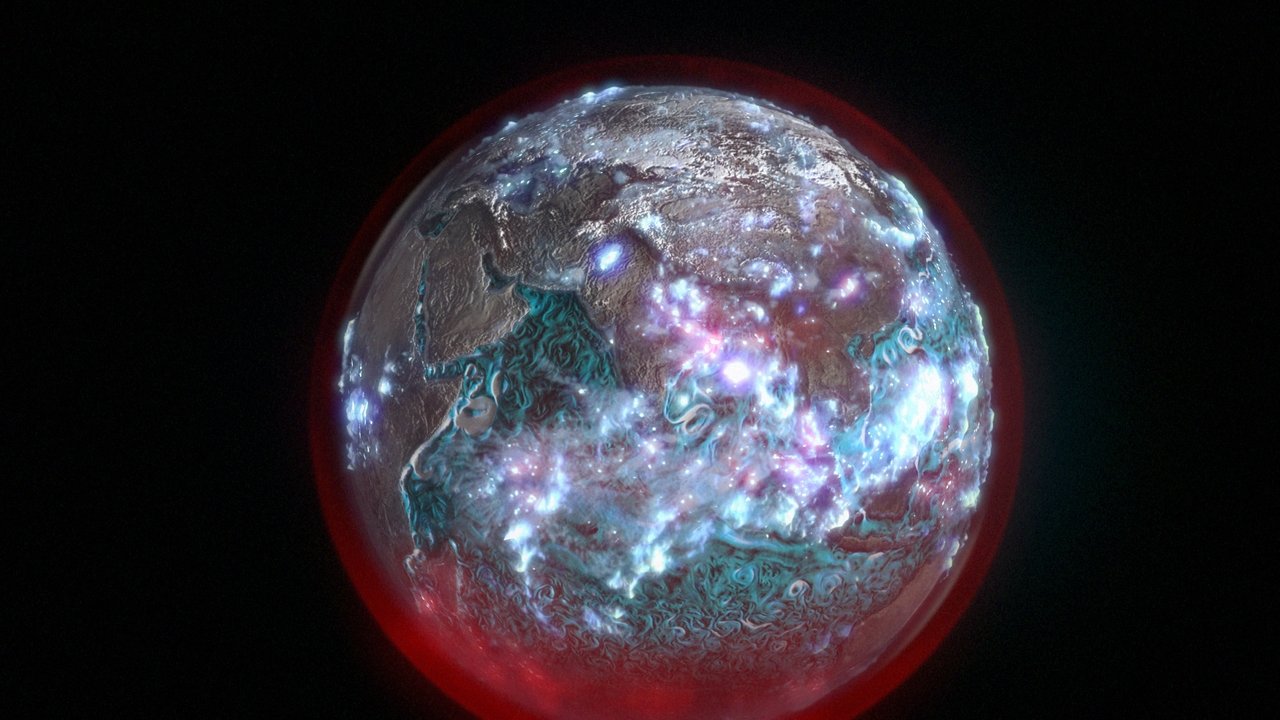
"Earth From Space" is a groundbreaking two-hour special that reveals a spectacular new space-based vision of our planet. Produced in extensive consultation with NASA scientists, NOVA takes data from earth-observing satellites and transforms it into dazzling visual sequences, each one exposing the intricate and surprising web of forces that sustains life on earth. Viewers witness how dust blown from the Sahara fertilizes the Amazon; how a vast submarine "waterfall" off Antarctica helps drive ocean currents around the world; and how the sun's heating up of the southern Atlantic gives birth to a colossally powerful hurricane. From the microscopic world of water molecules vaporizing over the ocean to the magnetic field that is bigger than Earth itself, the show reveals the astonishing beauty and complexity of our dynamic planet.
Details
- Series
- NOVA
- Season
- Season 40
- Episode
- Episode 11
- Air date
- 2013-02-13
- Runtime
- 55 min
Episode context
Earth From Space is Episode 11 in Season 40 of NOVA. It aired on 2013-02-13. The runtime is 55 min.
Previous / Next
 Episode 10: Building Pharaoh's Chariot
3,600-year-old reliefs in Egyptian tombs and temples depict pharaohs and warriors proudly riding into battle on horse-drawn chariots. Some historians claim that the chariot launched a technological and strategic revolution, and was the secret weapon behind Egypt's greatest era of conquest known as the New Kingdom. But was the Egyptian chariot really a revolutionary design? How decisive a role did it play in the bloody battles of the ancient world? In "Building Pharaoh's Chariot," a team of archaeologists, engineers, woodworkers, and horse trainers join forces to build and test two highly accurate replicas of Egyptian royal chariots. They discover astonishingly advanced features, including spoked wheels, springs, shock absorbers, anti-roll bars, and even a convex-shaped rear mirror, leading one of them to compare the level of design to the engineering standards of 1930's-era Buicks! By driving our pair of replicas to their limits in the desert outside Cairo, NOVA's experts test the claim that the chariot marks a crucial turning point in ancient military history.
Episode 10: Building Pharaoh's Chariot
3,600-year-old reliefs in Egyptian tombs and temples depict pharaohs and warriors proudly riding into battle on horse-drawn chariots. Some historians claim that the chariot launched a technological and strategic revolution, and was the secret weapon behind Egypt's greatest era of conquest known as the New Kingdom. But was the Egyptian chariot really a revolutionary design? How decisive a role did it play in the bloody battles of the ancient world? In "Building Pharaoh's Chariot," a team of archaeologists, engineers, woodworkers, and horse trainers join forces to build and test two highly accurate replicas of Egyptian royal chariots. They discover astonishingly advanced features, including spoked wheels, springs, shock absorbers, anti-roll bars, and even a convex-shaped rear mirror, leading one of them to compare the level of design to the engineering standards of 1930's-era Buicks! By driving our pair of replicas to their limits in the desert outside Cairo, NOVA's experts test the claim that the chariot marks a crucial turning point in ancient military history.
 Episode 12: Mind of a Rampage Killer
What makes a person walk into a theater or a church or a classroom full of students and open fire? What combination of circumstances compels a human being to commit the most inhuman of crimes? Can science in any way help us understand these horrific events and provide any clues as to how to prevent them in the future? As the nation tries to understand the tragic events at Newtown, NOVA correspondent Miles O’Brien separates fact from fiction, investigating new theories that the most destructive rampage killers are driven most of all, not by the urge to kill, but the wish to die. Could suicide–and the desire to go out in a media-fueled blaze of glory–be the main motivation? How much can science tell us about the violent brain? Most importantly, can we recognize dangerous minds in time—and stop the next Newtown?
Episode 12: Mind of a Rampage Killer
What makes a person walk into a theater or a church or a classroom full of students and open fire? What combination of circumstances compels a human being to commit the most inhuman of crimes? Can science in any way help us understand these horrific events and provide any clues as to how to prevent them in the future? As the nation tries to understand the tragic events at Newtown, NOVA correspondent Miles O’Brien separates fact from fiction, investigating new theories that the most destructive rampage killers are driven most of all, not by the urge to kill, but the wish to die. Could suicide–and the desire to go out in a media-fueled blaze of glory–be the main motivation? How much can science tell us about the violent brain? Most importantly, can we recognize dangerous minds in time—and stop the next Newtown?
More episodes from this season
 Episode 9: Who Killed Lindbergh's Baby?
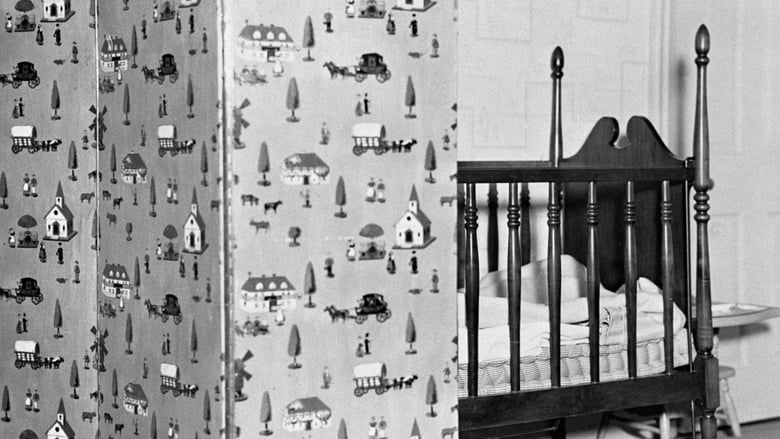
In the aftermath of his 1927 solo transatlantic flight, Colonel Charles Augustus Lindbergh–the Lone Eagle–became the most famous human being on earth. And when he and his lovely wife Anne produced an adorable baby son, Charlie, an eager press quickly dubbed him Little Lindy or sometimes just the Eaglet. But on the evening of March 1, 1932 Lucky Lindy's luck ran out. Bold kidnappers snatched his baby from the family home near Hopewell, New Jersey, while everyone in the house was awake. Negotiations with the kidnappers stretched out for weeks. But Little Charlie never came back. His body was discovered not five miles from Hopewell. Now, NOVA is reopening one of the most intriguing, grisly, and confounding crime mysteries of all time as a team of expert investigators employ state-of-the-art forensic and behavioral science techniques in an effort to determine what really happened to Lindbergh's baby and why.
Episode 9: Who Killed Lindbergh's Baby?
In the aftermath of his 1927 solo transatlantic flight, Colonel Charles Augustus Lindbergh–the Lone Eagle–became the most famous human being on earth. And when he and his lovely wife Anne produced an adorable baby son, Charlie, an eager press quickly dubbed him Little Lindy or sometimes just the Eaglet. But on the evening of March 1, 1932 Lucky Lindy's luck ran out. Bold kidnappers snatched his baby from the family home near Hopewell, New Jersey, while everyone in the house was awake. Negotiations with the kidnappers stretched out for weeks. But Little Charlie never came back. His body was discovered not five miles from Hopewell. Now, NOVA is reopening one of the most intriguing, grisly, and confounding crime mysteries of all time as a team of expert investigators employ state-of-the-art forensic and behavioral science techniques in an effort to determine what really happened to Lindbergh's baby and why.
 Episode 13: Meteor Strike
On February 15, 2013, a 7,000-ton asteroid crashed into the Earth's atmosphere over Russia with the power of 30 Hiroshima bombs. Within days, NOVA crews joined impact scientists in Russia as they hunted for clues about the meteor's origin and makeup.
Episode 13: Meteor Strike
On February 15, 2013, a 7,000-ton asteroid crashed into the Earth's atmosphere over Russia with the power of 30 Hiroshima bombs. Within days, NOVA crews joined impact scientists in Russia as they hunted for clues about the meteor's origin and makeup.
 Episode 8: Rise of the Drones
Drones. These unmanned flying robots–some as large as jumbo jets, others as small as birds–do things straight out of science fiction. Much of what it takes to get these robotic airplanes to fly, sense, and kill has remained secret. But now, with rare access to drone engineers and those who fly them for the U.S. military, NOVA reveals the amazing technologies that make drones so powerful as we see how a remotely-piloted drone strike looks and feels from inside the command center. From cameras that can capture every detail of an entire city at a glance to swarming robots that can make decisions on their own to giant air frames that can stay aloft for days on end, drones are changing our relationship to war, surveillance, and each other. And it's just the beginning. Discover the cutting edge technologies that are propelling us toward a new chapter in aviation history as NOVA gets ready for "Rise of the Drones.
Episode 8: Rise of the Drones
Drones. These unmanned flying robots–some as large as jumbo jets, others as small as birds–do things straight out of science fiction. Much of what it takes to get these robotic airplanes to fly, sense, and kill has remained secret. But now, with rare access to drone engineers and those who fly them for the U.S. military, NOVA reveals the amazing technologies that make drones so powerful as we see how a remotely-piloted drone strike looks and feels from inside the command center. From cameras that can capture every detail of an entire city at a glance to swarming robots that can make decisions on their own to giant air frames that can stay aloft for days on end, drones are changing our relationship to war, surveillance, and each other. And it's just the beginning. Discover the cutting edge technologies that are propelling us toward a new chapter in aviation history as NOVA gets ready for "Rise of the Drones.
 Episode 14: Ancient Computer
In 1900, Greek sponge divers discovered a 2,000 year-old shipwreck containing a geared bronze mechanism whose workings have puzzled scientists for decades. New hi-tech imaging has revealed that this clockwork machine was the world's first computer.
Episode 14: Ancient Computer
In 1900, Greek sponge divers discovered a 2,000 year-old shipwreck containing a geared bronze mechanism whose workings have puzzled scientists for decades. New hi-tech imaging has revealed that this clockwork machine was the world's first computer.
 Episode 7: Decoding Neanderthals
Examining evidence about Neanderthals that sheds light on the hominids, which died off some 30,000 years ago. Included: geneticist Svante Pääbo's 2010 reconstruction of the Neanderthal genome, which posits that modern humans and Neanderthals interbred at some point in the distant past.
Episode 7: Decoding Neanderthals
Examining evidence about Neanderthals that sheds light on the hominids, which died off some 30,000 years ago. Included: geneticist Svante Pääbo's 2010 reconstruction of the Neanderthal genome, which posits that modern humans and Neanderthals interbred at some point in the distant past.
 Episode 15: Australia's First 4 Billion Years: Awakening
Hidden in the red hills of western Australia are clues to the mysteries of when the Earth was born, how life first arose, and how it transformed the planet.
Episode 15: Australia's First 4 Billion Years: Awakening
Hidden in the red hills of western Australia are clues to the mysteries of when the Earth was born, how life first arose, and how it transformed the planet.
 Episode 6: Doomsday Volcanoes
In April, 2010 the eruption of Iceland's Eyjafjallajökull volcano turned much of Europe into an ash-strewn no-fly zone, stranding millions of travelers. But was Eyjafjallajökull just the start? Now, an even more threatening Icelandic volcano, Katla, has begun to swell and grumble. Two more giants, Hekla and Laki, could erupt without warning. Iceland is a ticking time bomb: When it blows, the consequences could be global. As CGI takes us inside these geological monsters, we meet atmospheric scientists who are working to understand just how devastating an eruption could be—not just for air travel but for the global food supply and for Earth's climate.
Episode 6: Doomsday Volcanoes
In April, 2010 the eruption of Iceland's Eyjafjallajökull volcano turned much of Europe into an ash-strewn no-fly zone, stranding millions of travelers. But was Eyjafjallajökull just the start? Now, an even more threatening Icelandic volcano, Katla, has begun to swell and grumble. Two more giants, Hekla and Laki, could erupt without warning. Iceland is a ticking time bomb: When it blows, the consequences could be global. As CGI takes us inside these geological monsters, we meet atmospheric scientists who are working to understand just how devastating an eruption could be—not just for air travel but for the global food supply and for Earth's climate.
 Episode 16: Australia's First 4 Billion Years: Life Explodes
How did life storm the beaches and dominate planet Earth? Ancient Australian fossils offer clues in "Life Explodes." Half a billion years ago, Australia was still part of the super-continent Gondwana. The oceans were teeming with weird and wonderful animals, but the world above the waves remained an almost lifeless wasteland. All that was about to change, though. Host Richard Smith introduces Earth's forgotten pioneers: the scuttling arthropod armies that invaded the shores and the waves of green revolutionaries whose battle for the light pushed plant life across the face of a barren continent. Evolution continued underwater as well, with armor-plated fish experimenting with teeth, jaws, sex, and lungs. NOVA's prehistoric adventure continues with four-legged animals walking onto dry land—and the planet poised for disaster.
Episode 16: Australia's First 4 Billion Years: Life Explodes
How did life storm the beaches and dominate planet Earth? Ancient Australian fossils offer clues in "Life Explodes." Half a billion years ago, Australia was still part of the super-continent Gondwana. The oceans were teeming with weird and wonderful animals, but the world above the waves remained an almost lifeless wasteland. All that was about to change, though. Host Richard Smith introduces Earth's forgotten pioneers: the scuttling arthropod armies that invaded the shores and the waves of green revolutionaries whose battle for the light pushed plant life across the face of a barren continent. Evolution continued underwater as well, with armor-plated fish experimenting with teeth, jaws, sex, and lungs. NOVA's prehistoric adventure continues with four-legged animals walking onto dry land—and the planet poised for disaster.
 Episode 5: Inside the Megastorm
Was Hurricane Sandy a freak combination of weather systems? Or are hurricanes increasing in intensity due to a warming climate? How did this perfect storm make search and rescue so dangerous? "Inside the Megastorm" takes viewers moment by moment through Hurricane Sandy, its impacts, and the future of storm protection. Through first person accounts from those who survived, and from experts and scientists, "Inside the Megastorm" gives scientific context to a new breed of storms.
Episode 5: Inside the Megastorm
Was Hurricane Sandy a freak combination of weather systems? Or are hurricanes increasing in intensity due to a warming climate? How did this perfect storm make search and rescue so dangerous? "Inside the Megastorm" takes viewers moment by moment through Hurricane Sandy, its impacts, and the future of storm protection. Through first person accounts from those who survived, and from experts and scientists, "Inside the Megastorm" gives scientific context to a new breed of storms.
 Episode 17: Australia's First 4 Billion Years: Monsters
"Monsters" begins Down Under at the dawn of the Age of Dinosaurs. Host Richard Smith comes face-to-face with the previously unknown reptilian rulers of prehistoric Australia. NOVA resurrects the giants that stalked the Great Southern Land and discovers that some of these animals were among the largest ever to have walked the Earth. Others were some of the most dangerous. In the dry desert heart, scientists unearth an ancient inland ocean full of sea monsters. Opal fossils of some of these beasts paint a colorful picture of the exotic seascape, where long-necked plesiosaurs snacked on shelled creatures that grew as large as truck tires. The most fearsome was Kronosaurus, with a skull twice as long as T. rex. But reptiles didn't have the world all to themselves. Mammals like the enigmatic platypus lived alongside them, ready for their moment in the sun.
Episode 17: Australia's First 4 Billion Years: Monsters
"Monsters" begins Down Under at the dawn of the Age of Dinosaurs. Host Richard Smith comes face-to-face with the previously unknown reptilian rulers of prehistoric Australia. NOVA resurrects the giants that stalked the Great Southern Land and discovers that some of these animals were among the largest ever to have walked the Earth. Others were some of the most dangerous. In the dry desert heart, scientists unearth an ancient inland ocean full of sea monsters. Opal fossils of some of these beasts paint a colorful picture of the exotic seascape, where long-necked plesiosaurs snacked on shelled creatures that grew as large as truck tires. The most fearsome was Kronosaurus, with a skull twice as long as T. rex. But reptiles didn't have the world all to themselves. Mammals like the enigmatic platypus lived alongside them, ready for their moment in the sun.